Silver Skates
Hans Brinker, or The Silver SkatesThe Silver Skates are the coveted prizes at the skating match arranged by Hilda van Gleck for Madame van Gleck’s birthday. They give the competition a visible reward, but their meaning extends beyond possession: for Gretel Brinker, winning them turns private longing into public recognition, and the family remembered by the Van Glecks becomes inseparable from the little girl who won them.
The Prize and Its Promise
The prize is announced as a splendid pair of silver skates for the best skater, and the match is to be held on the twentieth. The prospect immediately takes hold of the children. They debate the skates’ appearance with the excited uncertainty of people imagining an object they have not yet seen: some insist they have bells, others dispute it, and the stories include straps and buckles. Hilda settles the central question by explaining that the girls’ pair has bells, while the boys’ pair bears an arrow engraved on its sides. The prizes are thus related but distinct, marked for the two competitions by different details.
Hilda has helped make the race possible, and she tells Hans Brinker and Gretel that the ranks are open to anyone. She urges them to enter because they can skate well. The invitation presents the contest as available to all, but Hans’s answer makes clear that formal openness does not remove the practical obstacle: the children’s skates are made of hard wood, become damp, and then stick and trip them. The silver prizes promise excellence, while the conversation around them reveals how equipment affects a child’s chance to compete.
An Object Imagined Differently
As the race approaches, the silver skates occupy the children’s thoughts in unequal ways. Ben, who has become an accomplished skater, imagines them repeatedly and trusts his strength and speed on the ice. Rychie Korbes, Hilda, and Katrinka can scarcely think of anything but the coming race. The object is for them part of a shared excitement: a prize around which anticipation, rivalry, and conversation gather.
For Gretel, by contrast, the skates appear as treasures passing beyond her reach, not merely as something to win. Her longing is sharpened by the family’s circumstances and by the wooden skates Hans has described. Hans himself does not share the others’ bright vision of the prize during that winter night and the following day. The contrast makes the skates more than a decorative reward: before the contest, they register who can afford suitable equipment and who can only imagine what winning might mean.
The Race and the Award
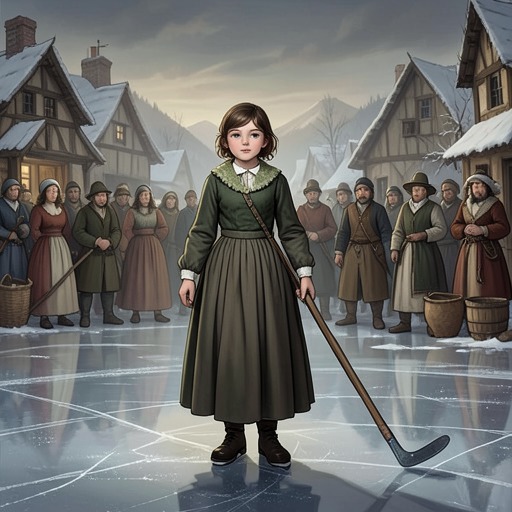
When the decisive race comes, Gretel is no longer merely playing. Something within her has determined to win, and she skates past the goal ahead of the other girls. The crier’s announcement is overtaken by the news already spreading through the crowd: Gretel has won the silver skates. The result changes her position in the scene as sharply as the finish changes the race. She had longed for the prize as something unreachable; now she is its winner, and the surrounding girls crowd around her.
The recognition is explicitly public. Hilda’s joyful voice reaches Gretel, and the narration declares that from this moment none will despise her: whether or not she is called a goose girl, she is acknowledged as queen of the skaters. The prize does not erase her background; instead, it makes her ability impossible to overlook. Hans turns with pride to see whether Peter van Holp has witnessed his sister’s triumph, but Peter is occupied with a troubled attempt to fix his skate strap.
At the later presentation, Gretel and Peter stand together at the center, in front of the other skaters. Madame van Gleck rises, and Gretel, trembling, tries to attend to the ceremony amid the surrounding buzz. Something dazzling is placed in her hand; Peter, too, holds a prize. In the sunshine the silver skates flash light across their happy faces. The award scene confirms that the two prizes belong to the winners of the girls’ and boys’ contests, while flowers are also presented to them and other skaters. Gretel gathers her skates and bouquets in her apron, presses them to her bosom, and hurries through the dispersing crowd to find her parents.
Recognition That Lasts
The skates’ significance reaches beyond the moment of victory. The book’s closing recollection asks the Van Glecks to remember the small, trembling girl sobbing on the mound before the Brinker cottage; they remember the darling child who won the Silver Skates. The object becomes a compact emblem of a particular reversal: the girl who had seemed socially easy to dismiss is preserved in the memory of those who arranged the prize as its deserving champion.
That ending also returns the award to its human setting. The skates are not described as changing Gretel’s character or her family’s circumstances by themselves. Their force lies in what the contest makes visible: Gretel’s speed, the joy she shares with her brother and parents, and the public acknowledgment that follows her victory. First imagined from a distance, then won on the ice and presented in the sunshine, the Silver Skates carry the story’s movement from longing to achievement and from being overlooked to being remembered.